AFM MiFIR transaction reporting fines: what firms need to know

Stop me if you’ve heard this one before…
The Dutch Authority for the Financial Markets (AFM) has introduced a new fining policy for firms that fail to notify it of substantial MiFIR transaction reporting breaches. Effective from 15 October 2026, the policy sets a €25,000 starting fine for a first infringement, rising to €50,000 for a second infringement within five years.
The message behind it should sound rather familiar to firms: identify reporting errors, investigate them, fix them and tell the regulator when something has gone wrong.
As we all know, these are the fundamentals of a properly functioning transaction reporting control framework and hardly a glorious revolution. Yet regulators are continuing to spell out their expectations in greater detail.
Are too many firms still falling short?
When must firms notify the AFM of transaction reporting incidents?
The new policy builds on the AFM’s existing guidance which already sets out quite specific expectations of firms.
Under that guidance, incidents that cannot be resolved by T+3 must be notified on T+4. Historic incidents must be reported immediately upon discovery, as must certain serious incidents.
The AFM also expects firms to implement a solution within three weeks of discovering an incident and complete any necessary back reporting within three months, unless additional time has been agreed. Importantly, firms are expected to investigate and document incidents even where they conclude that notification is not required.
This new fining policy goes a step further, setting out the circumstances in which a failure to notify the AFM will result in an administrative fine:
| Reporting failure | Threshold under the new policy |
| Missing or late transaction reports | More than 100,000 transactions or more than 25% of reportable transactions over at least two weeks |
|---|---|
| Incomplete, inaccurate or otherwise incorrectly reported transactions | More than 500,000 transactions or more than 50% of reportable transactions over at least four weeks |
Where a firm has not voluntarily notified the AFM and the relevant threshold has been exceeded, the starting fine is €25,000 for a first infringement, increasing to €50,000 for a second infringement within five years.
It’s important to emphasise that this new policy does not remove the obligations for notifying the regulator of incidents below those thresholds.
How does this compare with FCA transaction reporting expectations?
FCA Principle 11 (relations with regulators) has long required firms to deal with their regulators in an open and cooperative way and disclose appropriately matters of which the FCA would reasonably expect to be told about.
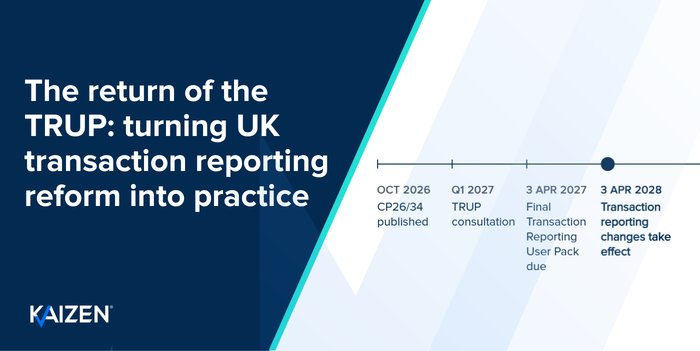
More recently, the FCA’s PS26/15, Improving the UK transaction reporting regime has reinforced these expectations. The new transaction reporting framework goes live on 3 April 2028.
In particular, MAR 14.15.7R expressly requires a transaction reporting firm to notify the FCA promptly where it submits or cancels a transaction report under MAR 14.15.3R to address reporting errors or omissions.
The notification requirement is not new but the FCA has introduced more explicit guidance on the incident management arrangements firms should maintain. These include identifying and assessing incidents, root-cause analysis, remediation, internal escalation and maintaining an auditable record of decisions, including those concerning regulatory notification.
If you don’t look, you won’t find
Voluntary notification presupposes that a firm has sufficient controls in place to identify reporting errors and omissions in the first place. The absence of identified problems is not necessarily evidence that reporting is accurate.
The AFM has also announced that it will conduct periodic checks to establish whether firms are voluntarily reporting incidents. This is therefore more than a statement of expectations; there is a clear intention to test compliance with them.
Taken together, the AFM’s existing incident guidance, its new fining policy, FCA Principle 11 and the forthcoming MAR 14.15 requirements reinforce a straightforward supervisory expectation: firms should have effective arrangements to prevent, detect, investigate, escalate, notify and remediate transaction reporting failures.
None of this is new in principle
What is perhaps more telling is that regulators still feel the need to spell it out. And that leaves firms with a couple of questions:
- Are we confident that our controls are finding the problems we ought to be telling the regulator about?
- And do we have the right policies of our own in place to inform the regulator when they are?
Get in touch with us for a health check of your reporting quality or a review of the effectiveness of your MiFIR transaction reporting controls.