The return of the TRUP: turning UK transaction reporting reform into practice
The FCA has published CP26/34, the latest step towards the new UK transaction reporting regime. Matthew Vincent looks at what firms need to know and why historical remediation should be a particular focus for firms.
Having spent the summer working through PS26/15, we now have the next instalment: CP26/34, Preparing for the new transaction reporting regime.
Those of us who worked with previous iterations of the Transaction Reporting User Pack (TRUP) are probably feeling a little nostalgic.
CP26/34 doesn’t rewrite the reforms announced in August. Instead it starts putting more practical detail around how firms will implement them. The FCA is consulting on guidance, transitional provisions and consequential amendments while also setting out how relevant existing guidance could be carried across into a new TRUP. Draft reporting schemas and validation rules have also now been published.
From policy to practical examples
There is plenty for implementation teams to work through. The consultation addresses areas including client indicators, Conditional Single-Sided Reporting, derivatives, branch execution, equity swaps, strike prices and package transactions, alongside a deeper dive into the handbook text and the treatment of historical corrections.
PS26/15 gave firms the shape of the new regime; attention now turns to how those rules work when applied to firms’ actual reporting models, systems and data.
The FCA is also actively asking whether further examples are required. That makes this consultation an opportunity for firms to identify areas where the rules may be clear on paper but less straightforward when applied in practice.
Unfortunately the past, this time, cannot be forgotten
One proposal in particular requires attention from firms.
Unlike the transitions in November 2007 and January 2018, the proposed arrangements would mean corrections to historical transactions submitted after 3 April 2028 need to use the new format.
That creates an interesting practical issue for firms with historical reporting problems still being investigated or remediated as implementation of the new regime gathers pace.
Historical remediation could become a huge implementation problem if remediation and the transition to the new regime are running in parallel.
That said, the reduction in the default back reporting period from five years to three years should reduce the burden. The FCA estimated that this change alone could save firms £11.9 million annually. But historical reporting doesn’t disappear as an issue: the FCA has retained the ability to require firms to go back as far as five years in cases of serious reporting failings.
So firms should be thinking now about the remediation work already in their pipeline.
- What is likely still to be open as April 2028 approaches?
- How will corrections be made under the new format?
- And does the transition affect how remediation work should be prioritised over the next 18 months?
April 2028 may be the start of a new reporting regime but it won’t necessarily provide a clean break from the old one.
An opportunity to fill the gaps
The FCA is specifically asking where firms need further guidance or practical examples before implementation.
We look forward to participating in the working group discussions over the coming weeks as those gaps are identified and the practical details teased out.
For firms, this is also the opportunity to put the proposed guidance against their own business models. If there are scenarios where the answer isn’t clear, now is the time to raise them rather than discover them during implementation.
The timetable
The consultation closes on 6 November 2026, giving firms a relatively short window to respond.
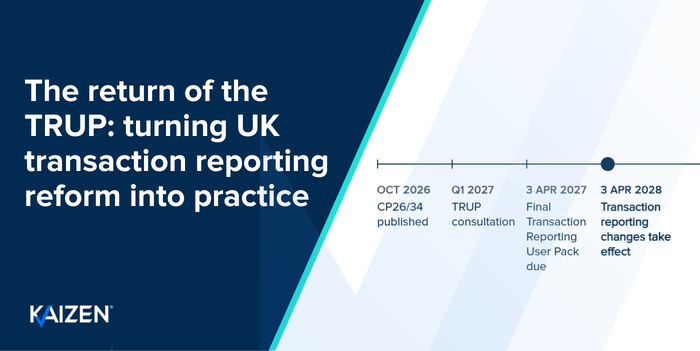
The FCA then plans to consult on the new Transaction Reporting User Pack in Q1 2027, with the final User Pack due by 3 April 2027 – exactly 12 months before the new regime goes live on 3 April 2028.
Judging by the questions and tone of this consultation, it seems unlikely that the final version will require firms to radically revise their implementation plans in the first half of next year.
But the devil remains in the detail, and firms still need to do the hard yards: working through the new MAR text and applying it to their own products, systems and business models. There are still uncertainties and CP26/34 gives the industry a useful opportunity to seek clarification before the implementation work gets much further down the road.
To misquote Norman Lamont, the green shoots of simplification are here but watch for the thorns hidden in the long grass.
To discuss the details of the CP with Matthew or for a conversation about preparing for the updated regime, please get in touch.