FCA Transaction Reporting Update: Proposed Key Changes in CP25/32

The Financial Conduct Authority’s (FCA’s) Discussion Paper and more recent Consultation Paper on Improving the UK Transaction Reporting Regime signal more than a revision of the reporting rules. They point to a much broader shift in the FCA’s view of data: both what it collects and how it uses it.
As the FCA consults on its proposals to reduce cost and complexity, it is clear about its objectives:
“We want to clarify and streamline transaction reporting requirements so firms can improve the quality of data they submit. We expect the proportion of complete, accurate and timely transaction reports to increase as a result.”
This statement reflects the core message emerging from both DP24/2 and CP25/32. On one level, the reforms aim to modernise the UK transaction reporting regime, remove redundant requirements and align it more closely with the FCA’s statutory objectives. But beneath this sits a second theme: regulators are increasingly relying on regulatory data for surveillance, risk assessment and policy decisions, and that increasing reliance inevitably brings greater scrutiny.
From supporting a statutory objective to a strategic data asset
A decade ago, transaction reporting was seen as helping the FCA identify potential instances of market abuse and to combat financial crime. Today, the FCA describes a much broader remit. Transaction reports have evolved into a strategic regulatory data asset which underpins multiple functions – supervision, enforcement, market monitoring and policy design.
Across the two papers, the FCA sets out an expanding set of uses:
- Market abuse – firstly, detecting, investigating and preventing market abuse remains the regulatory reporting’s central purpose, and the FCA is clear that incomplete or inconsistent data undermines its ability to act quickly and confidently.
- Financial crime – the FCA also links transaction reporting to preventing and disrupting financial crime, reflecting the growing convergence between market oversight, conduct supervision and financial crime monitoring – where transaction-level reporting provides traceability and evidence.
- Functioning of markets – beyond misconduct, reporting data also supports the FCA’s understanding of how markets function in practice: assessing liquidity, tracking trading behaviour, identifying disruptions and monitoring resilience.
- Direct supervision – increasingly, it is also used to supervise firms more directly. For example identifying risk signals, weaknesses in controls and compliance issues. Reporting quality is no longer an operational footnote; it influences supervisory priorities and drives engagement.
- Evaluation of rules – the FCA emphasises that its decisions must be grounded in data and an evidence-based understanding of markets. Transaction reports help all regulators, including the Bank of England and Prudential Regulation Authority, assess how rules influence behaviour and where emerging risks are building. The data is used not only to implement policy, but also to evaluate whether rules are working as intended, and whether reforms are needed.
- Measuring market stress – the FCA also explicitly references the use of transaction reporting during periods of stress, where timeliness and completeness become critical in assessing liquidity and volatility pressures, concentration risks and disorderly market conditions.
- Data sharing – reporting is increasingly part of cross-authority coordination. Transaction data is shared with other bodies, such as the Bank of England, to support risk monitoring in sovereign debt and bond markets. This underlines that reporting quality is not simply an FCA issue, but also feeds into wider financial stability intelligence.
CP25/32: a material reduction in what firms must report
Against this backdrop of a growing reliance on data, the consultation paper proposes a reduction in requirements. The headline changes include:
- reducing the number of transaction reporting fields from 65 to 52, removing 13 fields from the current dataset; albeit with five fields that are effectively already removed using a reduction in their supervisory priority
- removing the reporting obligation for around six million EU-only instruments, i.e. instruments only traded on EU venues
- removing FX derivatives from scope
- shortening the default back-reporting period from five years to three; and
- providing clearer guidance on complex areas such as swaps to improve reporting consistency between firms
- removing the obligation to report a limited set of corporate actions.
Taken together, these proposed changes represent a move toward a more targeted and proportionate dataset aligned with what the FCA genuinely needs, and specifically designed to reduce unnecessary complexity.
Reduced burden should increase data quality
A theme running through CP25/32 is that simpler reporting should enable better reporting. The FCA’s logic is straightforward: if requirements are clearer and more proportionate, firms will spend less time wrestling with complexity and remediation and more time ensuring that the remaining fields are complete, accurate and timely.
The FCA is explicit that it expects quality improvements, and it reinforces that expectation in several ways:
- Streamlining and clarity should reduce misinterpretation and inconsistency, lowering the rate of rejected or inaccurate reports.
- Removing low-value fields and obligations refocuses resources on the data the FCA actually relies on.
- Reduced scope lowers operational complexity, removing failure points in mapping, controls and remediation.
- Stronger baseline reporting should reduce the frequency of ad hoc follow-up data requests, improving efficiency for both firms and the regulator.
- Finally, the FCA makes clear it will measure improvement through observable indicators such as acceptance rates, error alert ratios and corrective reporting ratios, alongside supervisory trends. This is a clear signal that quality will be monitored and improvement expected.
Improving competitiveness is not deregulation
These reforms will likely require implementation by early 2028 and may not be the “white heat” of technological change UK Prime Minister Harold Wilson envisaged in the 1960s. But they do reflect the same modernisation theme: regulation must adapt, be simpler and be more proportionate to today’s environment.
This is where the FCA’s international competitiveness and growth objective matters. Not as a licence to weaken standards, but as a mandate to make regulation more effective and less burdensome while remaining anchored in allowing the regulator to achieve its consumer protection and market integrity objectives. Done well, reform becomes a strategy: simpler rules, better supervision, less friction and a regulatory regime that protects trust in UK markets while promoting investment and innovation.
What happens next?
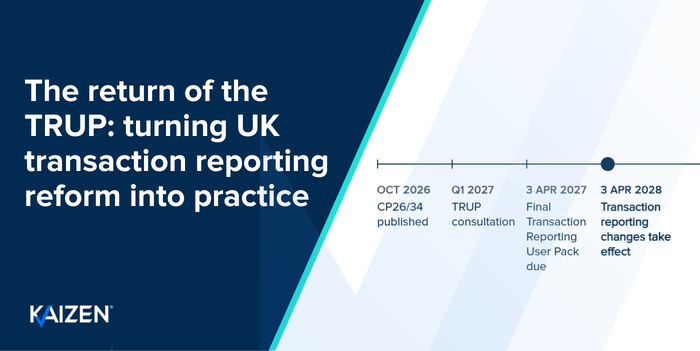
The consultation closes on 20 February and impacted firms should respond either individually or collectively via a trade association. Kaizen is working with several trade associations to support their members in understanding the proposed changes and their impact. A policy statement will follow from the FCA with the expected changes, work will commence on revised reporting guidelines, and firms will have until early 2028 to implement the required changes.
The direction of travel is clear. The FCA is moving towards a streamlined reporting framework designed to support an expanding set of uses. But firms must be aware that with increased reliance on data comes increased scrutiny. Firms should read CP25/32 as simplification, not deregulation. It is a proposed reduction in burden coupled with a sharper focus on quality. With this comes a stronger expectation that firms deliver data that regulators and other agencies can rely on.
There are undoubtedly benefits for industry. But the regulator’s new agenda includes strong data quality expectations – and firms should not lose sight of them.
For a conversation with Matthew or one of our regulatory experts about the FCA’s proposals or for a free health check of your MiFIR transaction reporting data quality, please get in touch.